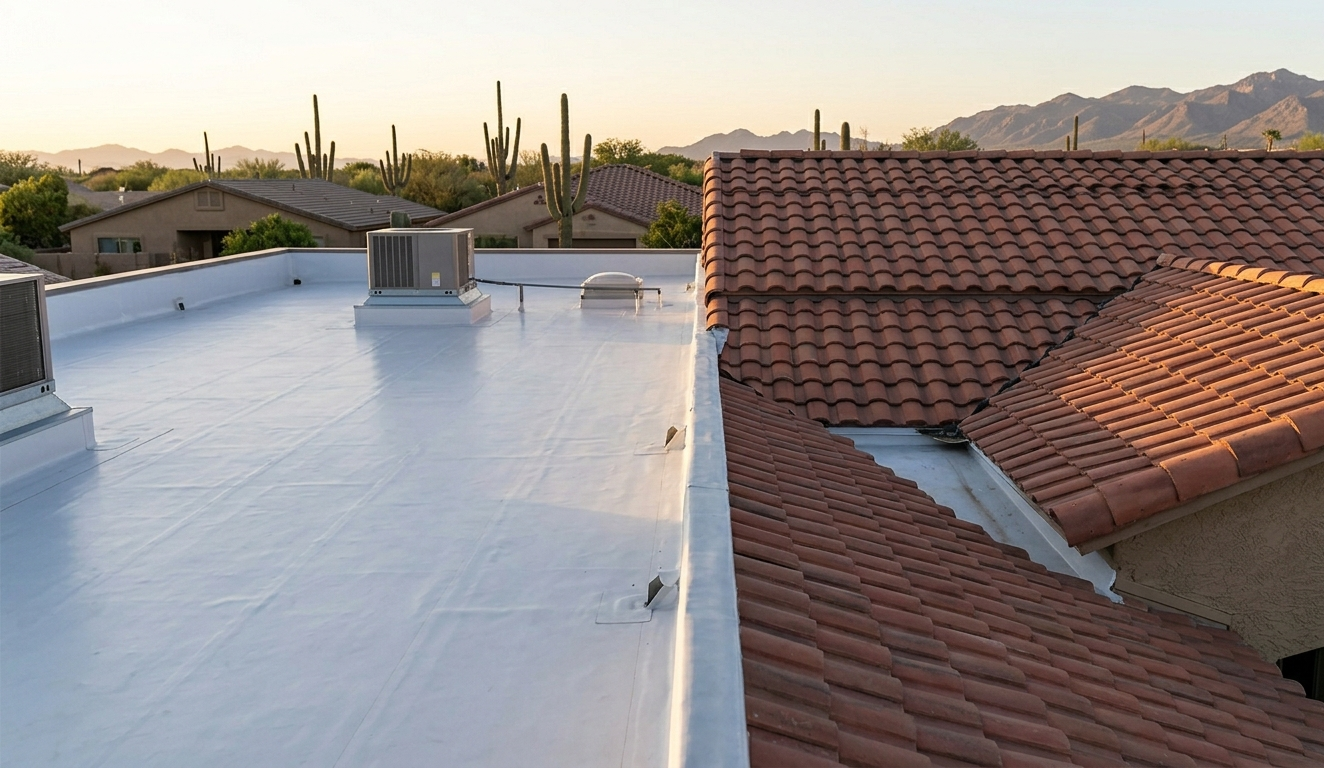
Both systems are highly common in Arizona for entirely different reasons. Arizona features a significantly higher percentage of flat and low-slope roofs than most other states, particularly across commercial construction and mid-century residential roofing designs. Meanwhile, pitched roofs heavily dominate newer residential developments.
Both configurations offer distinct advantages, specific maintenance needs, and unique failure modes. Homeowners often inherit one of these systems without fully understanding how it works or what it requires to avoid a premature roof replacement.
Flat roofs are not actually perfectly flat; they are engineered with a very slight slope designed to safely direct water toward drains or scuppers. Unlike traditional systems, a flat roof utilizes a continuous membrane rather than individual, overlapping pieces. This means your home's waterproofing depends entirely on the absolute integrity of that membrane and its seams.
The most common residential flat roofing systems in the Tucson area are single-ply and two-ply modified bitumen membrane systems, alongside traditional hot mop applications. While each has slightly different installation characteristics, they all share a similar practical lifespan—requiring a full roof replacement around the 20-year mark.
They also share the exact same core maintenance requirement: a professional recoating every 3 to 5 years to shield the membrane and extend its life. TPO is also available as a premium, low-maintenance alternative that is common in commercial applications, but most residential flat roofs in our area rely on standard membrane systems. Regardless of the specific material, the primary vulnerabilities remain the same: seams and penetrations are where roof leaks begin.
Pitched roofs shed water naturally through gravity, slope, and strategic layering. Shingles, tile, and metal panels overlap in a precise manner that directs water downward and completely off the roof before it can find a path inside.
This watershed system is highly intuitive and generally more forgiving of minor wear and tear than a flat membrane system. Because individual pieces overlap, a single, isolated failure point does not instantly expose the entire roof deck to water intrusion.
Aesthetic Appeal: Features a lower profile that is perfectly suited to the classic desert architectural aesthetic and is highly common in older, historic Tucson neighborhoods.
Accessibility: Offers easier and safer physical access for routine maintenance, inspections, and HVAC servicing.
Versatility: Can be utilized as functional outdoor living space in certain structural applications.
Efficiency: Elastomeric coating systems can significantly extend the system's lifespan while boosting your home's energy performance.
Critical Drainage: Proper drainage is absolutely vital; a single clogged drain or scupper can result in ponding water that heavily stresses the membrane.
Shorter Lifespan: Features a shorter overall lifespan than a well-installed tile or metal roof, requiring a roof replacement around the 20-year mark for most residential membrane systems.
Mandatory Maintenance: Recoating every 3 to 5 years is a required maintenance task, not an optional one; skipping this step drastically shortens the system's life.
Seam Vulnerability: Regular seam inspections are essential, as the extreme heat expansion and contraction in Arizona heavily stresses these seams over time.
Maintenance Dependent: The roof is highly dependent on consistent, quality maintenance to successfully reach its maximum lifespan potential.
Natural Drainage: Offers superior natural drainage because water sheds away rapidly rather than sitting or ponding.
Longevity: Delivers a much longer potential lifespan, particularly when premium tile or metal materials are used.
Resale Value: Presents a more visually traditional look that is often highly preferred by prospective buyers for resale.
Forgiving Design: Generally proves to be more forgiving of minor, short-term maintenance lapses.
Shingle Degradation: Standard asphalt shingles consistently underperform compared to national averages due to intense desert heat.
Underlayment Failure: Heavy tile systems require comprehensive underlayment attention and potential roof repair around the 20 to 25-year mark.
Complex Flashing: Metal flashing at complex intersections—such as valleys, hips, chimneys, and walls—requires highly skilled installation and periodic inspections.
The Hybrid Roof Reality
Many homes in Southern Arizona actually feature a hybrid design—a flat roof section over a garage, patio, or addition, and a pitched roof section over the main living area. These hybrid configurations require expert attention at the transition point between the two separate systems, as this junction is frequently where water finds its way into a home.
Whether your home features a flat roof, a pitched roof, or a complex hybrid combination, West Coast Roofing has the specialized expertise to handle all your repair, maintenance, and roof replacement needs throughout Southern Arizona. We provide comprehensive, completely free roof inspections for homeowners who want an honest assessment of exactly where their system stands.


 BēST Roofer Marketing